
Throughout our careers, I am sure we have all had ups and downs. Sometimes, that shows up in feeling overwhelmed, wondering whether we’re making an impact, thinking, “There has got to be something more,” or realizing, “This is amazing! What an honor to be doing this!”
Earlier on in my career, I bounced between positions quite a bit. Not proud of it. Just being honest and hindsight is 20/20.
In retrospect, it was most commonly about an inner lack of peace or frustration with the current role. An unmet desire for me. An ignorance (stupidity?) that I knew something better was on the other side. I assumed that me moving from Role “A” to Role “B” or from Manager “1” to Manager “2” would solve that problem.
Then… I realized that Roles A, B, C, D… did not fill that gap.
Then… I realized that Managers 3, 4, 5… did not fill that gap either.
I think there are multiple sayings that go something like:
“If every employee, peer, friend, or boss eventually becomes the problem, you should examine the common denominator.”
For those that may have missed the point above… YOU may be the common denominator.
To be abundantly clear – I really enjoy my vocation. Longer story for another day, but the summary being that I feel very thankful & called to do what I am doing today.
This post is about recognizing that there is a “Time for everything“… about recognizing life’s patterns.
3 For everything there is a season, and a time for every matter under heaven:
2 a time to be born, and a time to die;
a time to plant, and a time to pluck up what is planted;
3 a time to kill, and a time to heal;
a time to break down, and a time to build up;
4 a time to weep, and a time to laugh;
a time to mourn, and a time to dance;Ecclesiastes 3:1-4 (ESV)
For me, there is a pattern that has become very evident. A cyclical nature to heavier seasons and lighter seasons. Seasons of a ton of work and seasons where the work naturally dials back.
I feel like Farmers learn this very early on. In case you are curious… I am not a farmer.
If I were to assume and overly simplify farming … it would be something like:
| Stage | Months | Farming |
|---|---|---|
| 1. Prepare | Jan–Feb | Till, enrich, plan |
| 2. Plant | Mar–Apr | Plant seeds |
| 3. Nurture | May–Aug | Water, fertilize, weed, protect |
| 4. Harvest | Sep–Oct | Gather the crop |
| 5. Rest & Renew | Nov–Dec | Let the field recover |
I can only imagine that Step 2 – Planting and Step 4 – Harvesting are very high in physical effort. I am confident that the other stages also take significant effort… just likely a different type or focus of effort.
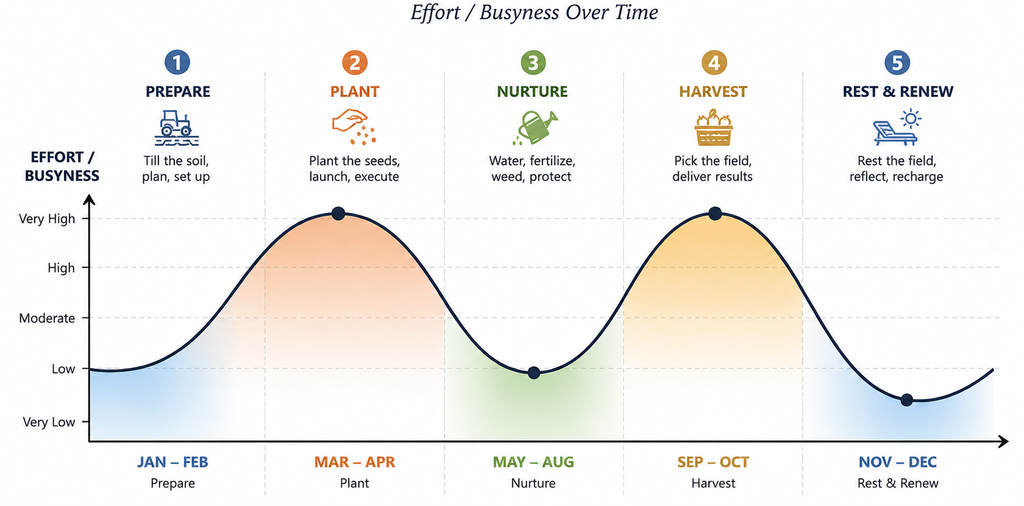
As mentioned before, I have realized a similar cyclical pattern in my life as well. My busy months or quarters are different than the above farming cycle – but similar nonetheless.
For me, recognition of cycle has normalized my response (for the most part) to when the cycle fluctuates.
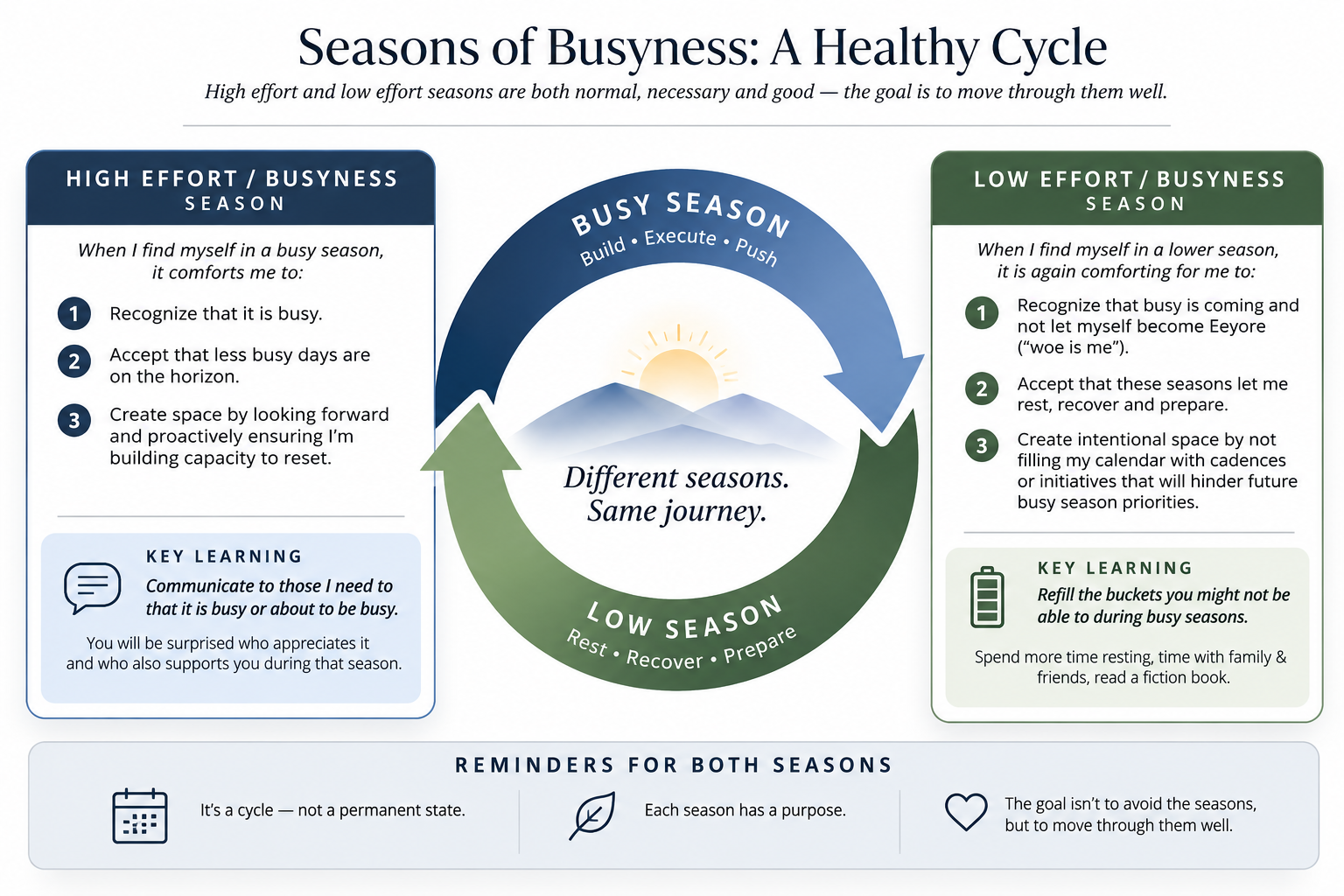
When I am in the “high effort/busyness” seasons – it comforts me to:
- Recognize that it is busy
- Accept that less busy days are on the horizon
- Create space by proactively looking forward and ensuring that I am creating capacity to reset
KEY learning for me when I find myself in this season is to Communicate to critical people in my life that it is busy or about to be busy. You may be surprised by who appreciates that insight and who comes alongside to support you during this season.
Then when I am in one of the “low effort/busyness” seasons – it is again comforting for me to:
- Recognize that busy is coming and do not let myself become Eeyore (“woah is me”)
- Accept that these seasons let me rest, recovery, and prepare.
- Create intentional space by proactively ensuring that I am not filling my calendar with cadences or initiatives that are going to hinder future busy season priorities.
KEY learning during this season is to Refill the buckets you might not be able to during Busy seasons. Spend more time resting, time with family & friends, read a fiction book.
I’m learning that “Refill” & “Rest” are a weak point of mine. I don’t do “still” very well.
Recently I was reading a book, and it emphasized that Busyness or Stress itself is not the problem it’s the lack of recovery.
Dr. Heidi Debar of Mayo Clinic puts it, “It is the lack of recovery rather than the actual stressor itself that is critical.” (Link)
Our bodies are designed to respond to stress and then return to baseline. The problem comes when stress is repeated or prolonged without enough time to recover.
Over time, that lack of recovery can contribute to the physiological “wear and tear” known as “allostatic load” (fancy word…) .
Hope you find this as helpful as it is for me to have recognized these seasons.
Rest well.
-Matt
Leave a Reply